This is from today's office of readings and really struck me. I tried to trim it down for quick reading but there's so much greatness in it that in the end I left it alone.
From a commentary on the Diatessaron by Saint Ephraem, deacon
Lord, who can comprehend even one of your words? We lose more of it than we grasp, like those who drink from a living spring. For God’s word offers different facets according to the capacity of the listener, and the Lord has portrayed his message in many colours, so that whoever gazes upon it can see in it what suits him. Within it he has buried manifold treasures, so that each of us might grow rich in seeking them out.
The word of God is a tree of life that offers us blessed fruit from each of its branches. It is like that rock which was struck open in the wilderness, from which all were offered spiritual drink. As the Apostle says: They ate spiritual food and they drank spiritual drink.
And so whenever anyone discovers some part of the treasure, he should not think that he has exhausted God’s word. Instead he should feel that this is all that he was able to find of the wealth contained in it. Nor should he say that the word is weak and sterile or look down on it simply because this portion was all that he happened to find. But precisely because he could not capture it all he should give thanks for its riches.
Be glad then that you are overwhelmed, and do not be saddened because he has overcome you. A thirsty man is happy when he is drinking, and he is not depressed because he cannot exhaust the spring. So let this spring quench your thirst, and not your thirst the spring. For if you can satisfy your thirst without exhausting the spring, then when you thirst again you can drink from it once more; but if when your thirst is sated the spring is also dried up, then your victory would turn to harm.
Be thankful then for what you have received, and do not be saddened at all that such an abundance still remains. What you have received and attained is your present share, while what is left will be your heritage. For what you could not take at one time because of your weakness, you will be able to grasp at another if you only persevere. So do not foolishly try to drain in one draught what cannot be consumed all at once, and do not cease out of faintheartedness from what you will be able to absorb as time goes on.
[attribution: Discovered in the Universalis app. ]
Robin Soft though she sits on her four teal treasures my gaze of interest and care sets her heart beating first to freeze then to flee. I am sad that my tender attention disturbs her.
I like this. Maybe this new extreme will have a good moderating effect on the mainstream movies and shows that have gotten more and more fast paced - action every second - unrealistic. I know I like this because it's just the sort of thing that I liked in Brideshead, Pride and Prejudice and some other movies. They had a few seconds or even a whole scene where no one talked or moved much. (Don't even get me started on the camera swirls!)
I think that this shows that there is power in slowness and silence. And I think it's precisely because it's real. The one thing that worries me is this comment: "So we have to push the boundaries for each show, I think." said Moklebust. You don't ALWAYS have to push the boundaries. I think that misses the point of the realness.
Norway's Slow TV: Fascinating viewers for hours or days at a time
One axiom rarely observed on television nowadays is to "take it slow." And if you think that can't make for gripping TV, Seth Doane wants to tell you there's an entire country that would pointedly disagree:
It's television's version of taking a deep breath … a very long, very slow, deep breath.
It's called "Slow TV," and it's a surprising smash-hit in Norway.
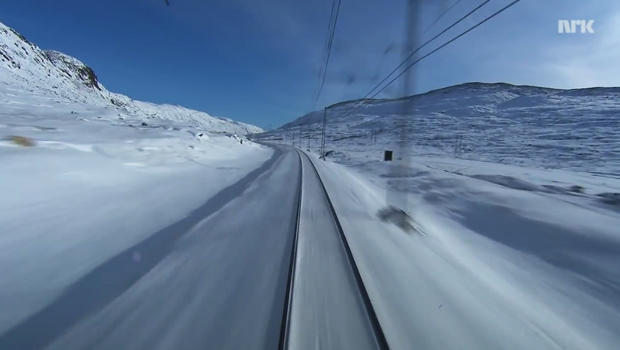
All aboard! Viewers shared a seven-hour train ride through Norway on the first installment of NRK's "Slow TV."
NRK2
Rune Moklebust and Thomas Hellum are the brains behind the whole thing.
"Did you know where this journey would lead, how successful it would be?" asked Doane.
"No idea at all," said Moklebust. "It's normally one of those ideas you get late night after a couple of beers in the bar, and when you wake up the next day, Ahh, it's not a good idea after all."
But much to their surprise, there was a green light from their bosses at Norway's public broadcaster NRK2.
"We actually like it being a bit strange and a bit crazy, because then it's more fun," said Moklebust.
Hellum added, "If the viewers laugh, or think, Wow, this is too crazy, that's basically the kind of reaction you really want from the viewers."
About a quarter of all Norwegians tuned in to watch some part of that train trip.
They ran historical clips when the train went through a tunnel, but other than some music, there was no narration, no plot, and -- thanks to public broadcasting -- no commercials.
Hellum admits his own show is boring. "Yes!" he laughed. "Much of life itself is boring. But in-between, there are some exciting moments, and you just have to wait for them."
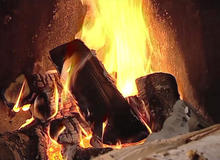
A scene from "National Firewood Night."
NRK2
Since the train, in 2009, they've experimented with other slow ideas, and folks at all levels have taken notice.
"I understand that in Norway, for example, one of the big hits on TV is National Firewood Night!" President Obama said at a State Dinner for the heads of five Nordic countries in May 2016. "This is true! Video of logs burning for hours."
Twelve hours in all!
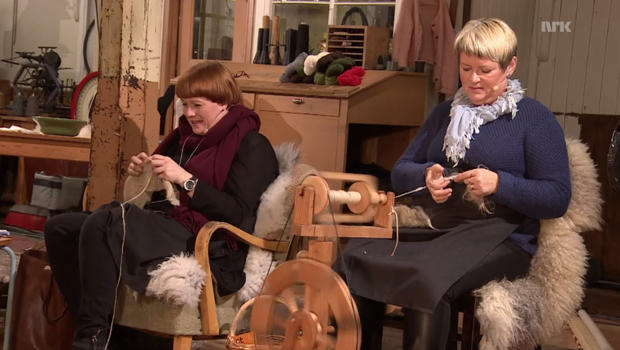
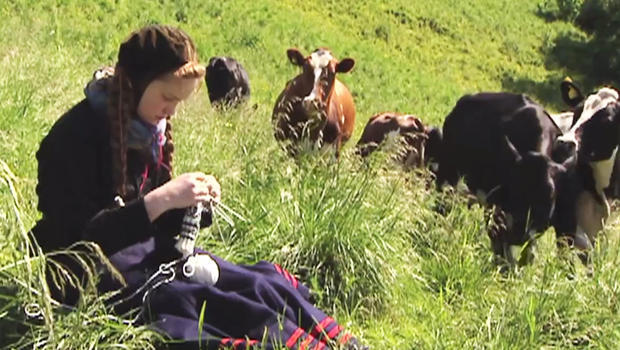
A "National Knitting Night" started, of course, with shearing the sheep; knitting the sweater came much later in the 13-hour broadcast.
The shows, Doane noted, "get slower, and slower, and slower."
"National Knitting Night" on NRK2's "Slow TV."
NRK2
"Well, it has to be unique -- not a copy of the last one," said Moklebust. "So we have to push the boundaries for each show, I think."
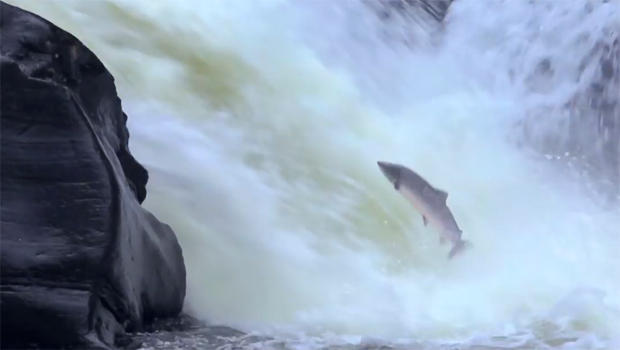
The show titled "Salmon Swimming Upstream" ran 18 hours -- and afterward, the head of the station said it felt "too short."
NRK's cameras caught endless salmon.
NRK2
So, is there a recipe for the perfect "Slow TV"? "It's important that it's an unbroken timeline, that you don't take away anything," said Hellum. "It's all the boring stuff in there, all the exciting things in there, so you as a viewer has to find out what's boring and what's interesting."
"It kind of requires you precisely to slow down, to kind of twist your head in a little bit of a different direction," said Espen Ytreberg, a professor of media studies at the University of Oslo.
Ytreberg said when he first heard about "Slow TV," he thought "the whole notion was weird, to tell you the truth. But it turned out that at least some of it I found surprisingly appealing."
Ytreberg likens Slow TV to opening a sort of window -- an escape valve -- from what he calls fast-paced, "eye-candy" TV. "When did we come to accept that television should be this accelerated, busy, intense, in-your-face-thing?" he said. "At some point, that became the norm."
Rune Moklebust thinks one image sums up their approach: "Once we passed a cow on one of our journeys, and we put a camera on it. And the camera just kept rolling, and we didn't cut away. And then you keep it, and you keep it, and then you keep it, and then, suddenly a story evolves: What is this cow doing? Why is it walking there? Where is it heading? Why is the cow alone?
"So suddenly, there comes a story out of it, and you have to see what happens."
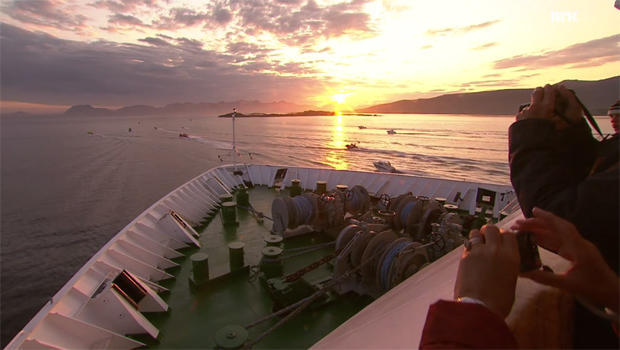
There was plenty of time to follow that cow, because they came across it while shooting an episode, which followed a cruise along Norway's coast.
Cameras came along for every minute of a cruise ship's 134-hour trip.
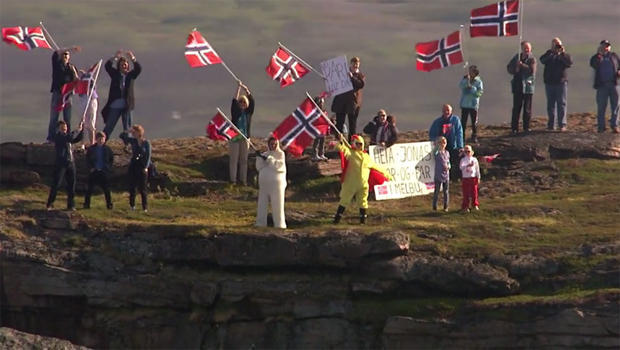
Norwegians lined the ship's route, often waving flags or welcoming it in port.
Well-wishers greet the arrival of the cruise ship broadcasting live on "Hurtigruten minutt for minutt."
NRK2
And there were unexpected cameos: A water skier in a mankini, for instance … even the Queen of Norway made a surprise appearance.
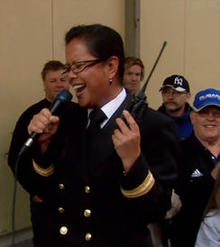
Purser Anna Bildstein-Hagberg belts out "Proud Mary."
NRK2
And the trip revealed some unexpected talent: Anna Bildstein-Hagberg, the purser on board, remembered how one night seemed a little quiet. "I just felt that, we need to rock 'n' roll a little bit."
So she picked up a microphone -- and became a breakout star! "Well, it wasn't meant like that!" she laughed.
"Slow TV" has been syndicated around the world and, since then, Bildstein-Hagberg gets recognized: "People from Australia come and just, 'It's you!'"
"Slow TV" episodes are special events; they're not on all the time. The creators want them to stand apart from regular programming.
All of this got us to thinking:
Doane showed Moklebust and Hellum one of "Sunday Morning"'s Moments of Nature which close each broadcast.
"And how many seconds do you dare to keep it?" Hellum laughed.
"Slow TV in the making?" Doane asked.
"Compared to other things, yes, definitely. And I guess you get a lot of good reaction on this one?"
"The audience loves the Moment of Nature, and they always want it to be longer."
"Exactly. So make it longer!" laughed Moklebust.
"That means this piece has to be shorter, so watch it!" Doane laughed.
Next time you hear about some correlation of, well, anything! from which is drawn a conclusion about causation - - - - make sure you have fresh batteries in your skept-o-meter!
On a single day last week year (forgot to publish this), St. Nicholas' feast day in fact, we were awed by getting close looks at some originals...
We had a little homeschool viewing of a handful of items from Marquette University's J.R.R. Tolkien collection. Then we headed over to the Milwaukee Art museum and were pleasantly surprised by their temporary exhibit of paintings on loan from Kenwood House. That includes Gainsborough's, Rembrants, and more. In fact, so much of the day running to my tastes that I can't find the right words.
They wouldn't let us photograph either of them so these web results will have to suffice while I describe the experiences.
http://www.marquette.edu/library/archives/tolkien.shtml Chapter 1 - An Unexpected Party. <-- We saw this!!! Typwritten by J himself. Did you know Thorin Oakenshield was originally called Gandalf?
Chapter 5 - Riddles in the Dark <-- We saw this too! This one in his own handwritting. His writing, with a fountain pen, was oddly elegant and hard to read at the same time. Actually, looking around you could see his frame of mind... when he was being precise he would slow down and the script was beautiful. And when the muse was pelting his mind he would scrawl.
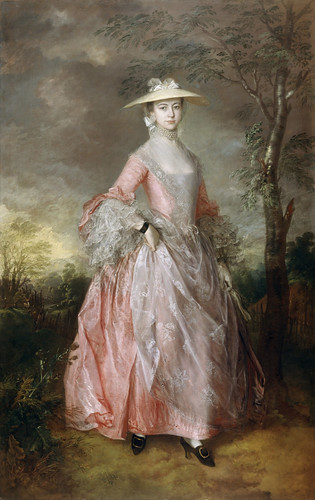
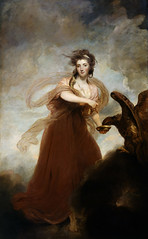
We also saw the original of the map that would eventually appear in the Hobbit. And then we saw the Gainsboroughs, Sir Thomas Lawrences and Sir Joshua Reynolds ... and more!
Energy is important. When energy becomes "free" imagination takes over about what is possible...
Fresh water from salt water? - no problem! Water
Continuous food growing season? - no problem! Food
Heat in winter and cool in summer? - no problem! Shelter
Recycling junk into new shelters, roads, anything? - possible! Green
Reducing toxic waste (or any waste) into benign elements? - possible! Green
Making diamonds out of coal? - possible!
Alchemy - making gold from lead? - possible!
(you might be surprised at how many non-luxury uses diamonds and gold have!)
Heck we could even MAKE gasoline and then recycle it if we choose to.
But it isn't free. yet.
And even when it is free we probably need a way to store it (if we get it from the sun... we will want to use it at night too... and so forth)
Even now we need a good way to store it so we can use it in our cars, so we can use it in our gadgets and to make better use of the sources we have when we can distribute over peak and non-peak hours of the day. As a matter of fact energy storage is really at the root of the same dream. Isn't it just energy that's STORED in batteries, gasoline, Uranium etc.? How we extract it, how we replace it for later use ... well THAT'S where the differences get bigger.
So I got to wondering how much energy is actually stored in our common energy sources. Thanks to Wiki I got some numbers and graphed them to make it easier to picture.
I found a few things kind of interesting...
- Uranium is amazing!! No wonder we go to such great, huge, expensive lengths to "burn" it.
- Gasoline is pretty amazing too. 50x the power of the best of those state of the art Lithium batteries in your laptop.
- But a hydrogen powered car would be 3x better than that! And would be exceedingly environmentally friendly - outputting fresh water instead of smoke and smog. Sweet.
- I was disappointed by the SuperCapacitor - not really earning it's "super" designation in this chart. It's all the rage in the electronics magazines and it certainly has it's unique virtues (easy/fast energy in, easy/fast energy out) but at 1/10th the density of an old lead acid battery it seems doomed to be used as a supplementary or targeted source of energy.
- And for that matter Lead Acid is pretty respectable for an old technology.
Sandy is the storm out on the east coast. Around 700 miles away it is causing havoc in Hoboken. But that's about 700 miles away. Here in Milwaukee we are seeing amazing waves in Lake Michigan caused by the very, very long arms of Sandy. If I try, with all my might, to blow out a match at my feet - I can't do it. Lifting and tossing thousands of gallons of water in each wave - across a 1400 mile radius!?!?! In-con-cievable.
If this is what the physical world is like... what is in store for us when what is hidden is revealed!
You can see the edge of Sandy in the sky here ... I think.
And just in case you thought I was exaggerating... this IS unusual for Milwaukee.
Alas, I don't think that the Dr. is hanging around here right now. Even when it's bigger on the inside than on the outside you have to be able to squeeze through a door. It is, however, a police call box. It is the right color. And it even has the nice light on top.
I am driving back and forth to work through a BOUQUET! I think these are tree sized flowers. And who arranged them?
Seriously, Wisconsin in the fall has it's beautiful stretches. But this year is extra intense. Was it the early warm spell in spring or the long dry spell in summer or something else? Who cares?
Either way I am once again astounded by the superabundance of this creation.
But please... don't watch only half!! As it goes between Mr. Darcy and Elizabeth
"I could wish, Miss Bennet, that you were not to sketch my character at the present moment, as there is reason to fear that the performance would reflect no credit on either [you or me]."
And watching only half the video will leave you with very confused ideas that will reflect no credit on either you or me.
Alicia read to all the kids for a while that morning.
Bernie glanced across the room and did this with the new art set!!!!
Bernie didn't even know she was glancing across the room at a painting done by her great-grandfather. It was fun to tell her that.
So it seems she's got art in the genes. Which is not to say that it only comes from her paternal great grandfather... her mother has a strong art streak too.
Just a note for travellers. Hot springs are a wonderful gift from mother nature. However, in order to soak in them we (i.e. people) sometimes need to tweak them - - - we want water that is not too deep, too hot, too narrow etc.
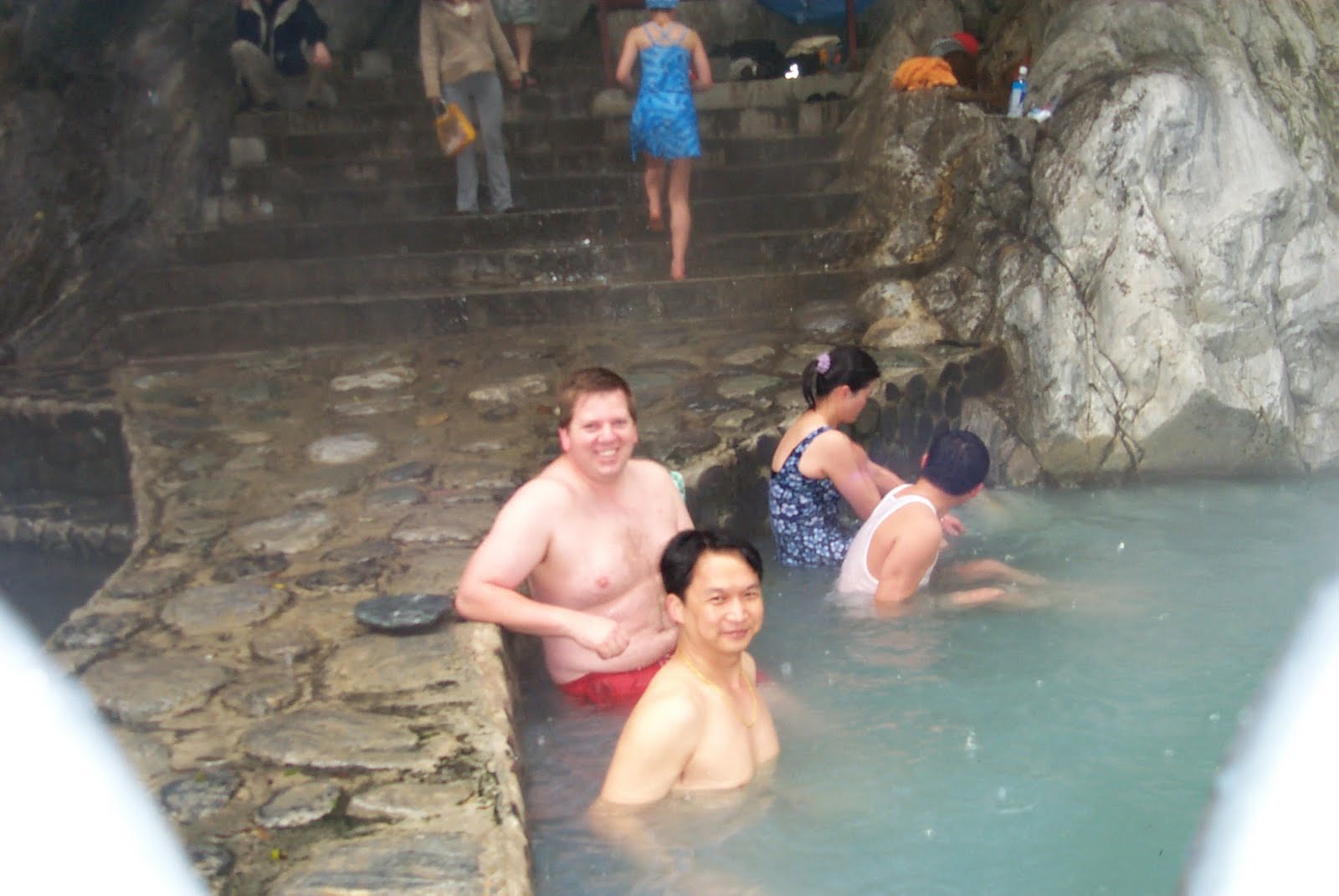
When I went to Taiwan's Taroko gorge there was a hot spring next to a river called Wenshan Hot Springs. The Taiwanese brilliantly made 3 pools for the water.
The hot water was captured in the first pool at full temperature. The pool was big enough for at least a dozen people and outfitted with a ledge to sit on so you could be immersed just up to your neck. Then a portion of the water flowed into another, bigger pool. It could hold about 40 people comfortably. The pool was shallow enough that you could sit in any part of it and be comfortably immersed. The brilliant part is that they mixed this water with some of the cold river water so that the temperature was "just right".
The third pool was again mixed for a more tepid temperature which appealed to people who preferred that. All three pools were situated on the river's edge - overlooking the torrent and some of the most amazing canyons and tropical vegitation I have ever seen and the blue skies and sun of Taiwan (OK the picture proves I didn't see blue skies and sun that day). They were sheltered just a bit by the cliff that had been cut by the river but basically open to the world. A delightful experience.
The hot springs on the north side of the island are a different experience. My friend Andrew tipped us off that the public ones tend to have some contamination (bodily fluids) and that the clean ones are almost all indoors. They are private affairs. Virtually all of them are piped into hot-tubs in confined, individual hotel-sized rooms for privacy. Even the one we saw that was open to the outside was a pool on a hotel rooftop. As such they are also done sans-stiches, aka clothing-non-grata, aka (ironically) au natural.
Thanks Andrew for saving us from ourselves!
I am wondering in retrospect whether the Taroko springs were also contaminated. If so I'd like to put in a retroactive "ick".
Update: Apparently the Wenshan hot springs are now closed. Their position under the cliff allowed for a rockslide that left at least one bather dead and others injured.
When you think about it doesn't it seem strange that a 10W LED light bulb needs a heavy heatsink with fancy fins when a 100W incandescent doesn't?
Here's what I have found.
A 100W incandescent light is too hot to touch - about 90-130C (200-270F). But that is using the surface of that glass bulb as the heatsink. The filament that actually gives the light is 2000-2500C (3600-4500F)!!! The gasses inside of the bulb actually don't carry heat to the surface of the glass at all. That's an advantage in this bulb since the heat is key for getting the light.
LEDs are semiconductors. Like most semiconductors (like all the ones that drive your cell phone, PC, iPod, etc.) in order to survive at all they need to keep their temperature (Tj) below 150C (300F). In order to have a decent lifetime and keep other parameters within control it needs to be closer to 85C (185F - a good temperature to brew coffee at). That's thousands of degrees cooler than the filament!!
The the actual light producing part, the LED junction, is tiny (less than 10 square mm). Since it is small it doesn't have enough surface area to get rid of the 10W* and still maintain this temperature. So it needs to have more surface area - which is the heatsink. The heatsink is made out of Aluminum since the metal carries the heat to its own surface pretty efficiently. Without the heatsink the LED would get too hot for a semiconductor (not too hot if it was a filament).
*10W is actually not used only by the LED. There are some other electronics inside an LED bulb that convert AC down to the low DC voltage that the LED needs. These parts are not perfectly efficient so they use some of the 10W themselves - which is as much as to say they generate heat too.
I can't believe I am writing a post with that title! OK Here goes:
We recently saw the movie Tangled for the second time (yes second) with my daughter and friends for her birthday. Alicia pointed out to a few friends that this movie has probably the most profound scene ever found in a Disney princess movie. She's right.
spoiler alert - don't read any further unless:
1) You have already seen the movie or
2) You don't expect to ever see the movie unless you need a good reason - I will give you that reason.
There are some key points that set this movie apart above most other princess movies from Disney. The hero is a he. Both the hero and heroine are smart (she is naive but smart).
The clincher is the climactic scene. While it is normal for a hero to save the heroine's life it is usually done, in this genre, with little doubt as to the success of the act and with only half-believable mortal danger.
Just as she is willing to sell her freedom for his life (truly heroic) Tangled departs.
He dies.
The redemptive deed is sudden and surprising. And he knows he will die. Seems a bit christian.
Tangled departs further. He sacrifices his life not for her physical life but for her freedom - life lived fully. A genuine masterstroke that earns this story a claim at being a real fairy tale. I hesitate to offend the sensitive by saying what they have already perceived; but this is seriously Christ-like.
The Academy has nominated it for 1 award - for original song. They overlook the profound masterwork in the story itself. I believe this movie will and deserves to become a long time favorite. (Note: Alicia can vouch that I am NOT in love with the music - I put up with it for the story).
Oh, and the horse Maximus? That's a bit of the best of Disney classic... he is 100% horse, 100% dog and 100% character. A great combination that can only be found in animation.
I love art. And I found a new site that looks like it serves up art really well.
1) High quality views that can be magnified (I can see brushstrokes; I can see details that are invisible when I look at the lowest zoom level, etc) [Can you tell what painting this detail is from??]
2) Viewing notes (use that >>i to get to them - - - and do READ MORE if it's there). The viewing notes actually tell you about the picture's content - not just the normal: Size, artist, date and museum.
3) Various ways to go from picture to picture
4) Museum tours (akin to streetview) (Actually, this is one thing that I would like to see improved... it would make sense if you just click on a picture to view the picture page but this streetview is still kind of 'dumb' that way).
As we were out walking this afternoon I mentioned that a 9 year old from Canada had recently found a maple leaf that he had certified as the LARGEST MAPLE LEAF IN THE WORLD!
A few moments later Bernie casually picked up a leaf from a leafpile laying out in the street for pickup. Since I hadn't heard how big the world record was I offered her no encouragement as she proceeded to carefully carry it all the way back home.
This is that leaf (and Bernie) (more technical pictures at the bottom)
This is the letter that Bernie (10) is submitting to the Guinness Book folks:
===============================================
Dear Sirs,
I found a large maple leaf that appears to beat the record size that we read about in the news.
My maple leaf (photos available)
Width = 16 - 5/16 inches
Height = 14 - 1/2 inches
(note: Stem does not extend below leaf so stem size seems not important)
Current record holder: "The width is 13 and 5/8 (inches) and then the length is 15 and 5/8 with the stem" [we weren't able to confirm this at the Guinness site but we found it here: http://newsdurhamregion.com/news/article/166373]
I don't know how he got there. I don't know where he went after. I only know that he seemed to be enjoying the "wild ride" in the slow traffic for about 5 miles.
We love this old 1938 Jimmy Stewart movie around this house. So you should see it!
If you see it you may be intrigued by this optimistic scene:
I remember in college another guy and I had an idea [....] We wanted to find out what made the grass grow green. Now that sounds silly and everything, but it’s the biggest research problem in the world today and I’ll tell you why. Because…there’s a tiny little engine in the green of this grass and the green of the trees that has the mysterious gift of being able to take energy from the rays of the sun and store it up. You see that’s how the heat and power and coal and oil and wood is stored up. Well, we thought if we could find the secret of all those millions of little engines in this green stuff, we could make big ones. And then we could take all the power we could ever need right from the sun’s rays. (Thanks http://1morefilmblog.com/wordpress/you-cant-take-it-with-you-capra-1938/ for transcribing it!)
Now that sounds pretty fresh in light of all the solar cell hubbub that's all the rage. In fact someone is going right for the green:
A North Carolina State University-led team has created 'artificial leaves – water-gel-based solar devices which can act like solar cells to generate electricity.
The devices show it's possible to make solar cells that more closely mimic nature, and could also be less expensive and more environmentally friendly
And you should watch that movie - that's only ONE of the good ideas in it! (Hint - most of them aren't about science topics - they are about a life well lived).
A friend recently asked if I knew how to recover his pictures from his crashed (Macintosh) hard drive. The "genius" store geeks had tried to read it by booting from another drive and just looking at this one. That didn't work. My friend wasn't ready to pony up for a level-2 recovery attempt - $750 whether or not the procedure was successful!!
Now, I have been pretty tuned into hard drives for years because of my profession. I have seen hard drives crash. I have used both manufacturer's and open source tools to read and interpret SMART data on drives. I have opened and examined hard drives that have suffered from shock, vibration, thermal torture and customer abuse. I have watched hard drives spin topless. I have painted them with Omegalaq and used thermocouples as thin as a hair to check internal temperatures. In addition I have read articles about the various degrees of data recovery possible (from freeware on up to thousand$). I thought I could offer some assistance.
Knowing that the drive didn't even work inside his laptop with an external boot I figured I would try to find a similar drive on ebay and swap in the disks. Yes there's a risk of contamination but I just wanted 1 pass to grab those files - just a few minutes of operation was all I asked. There was one in Australia with a datecode a few days away. But before I spend the $70 (plus who-knows-how-much shipping) I did just a little extra homework.
I found a guy talking about getting those few extra minutes by putting the drive in the freezer overnight and then using it. My young, geek cube-neighbor at work said he had heard about this but always worried about the condensation killing it too fast. He also said that Apple formats its drives in such a way that I would probably need a Linux OS to properly see it.
Since this was a SATA drive I was in luck. I have access to a little USB connected pod that can accommodate a SATA drive. So I put the whole thing in the freezer for a couple days and just ran the cables out to the host laptop (i.e. my work laptop with an Ubuntu install on it). After getting some advice about how to navigate around the command line (not my specialty - yet necessary due to the permissions issues on the Mac drive) we were able to run the drive for hours and recover all the pictures!